Vibration Analysis of large rotating machinery
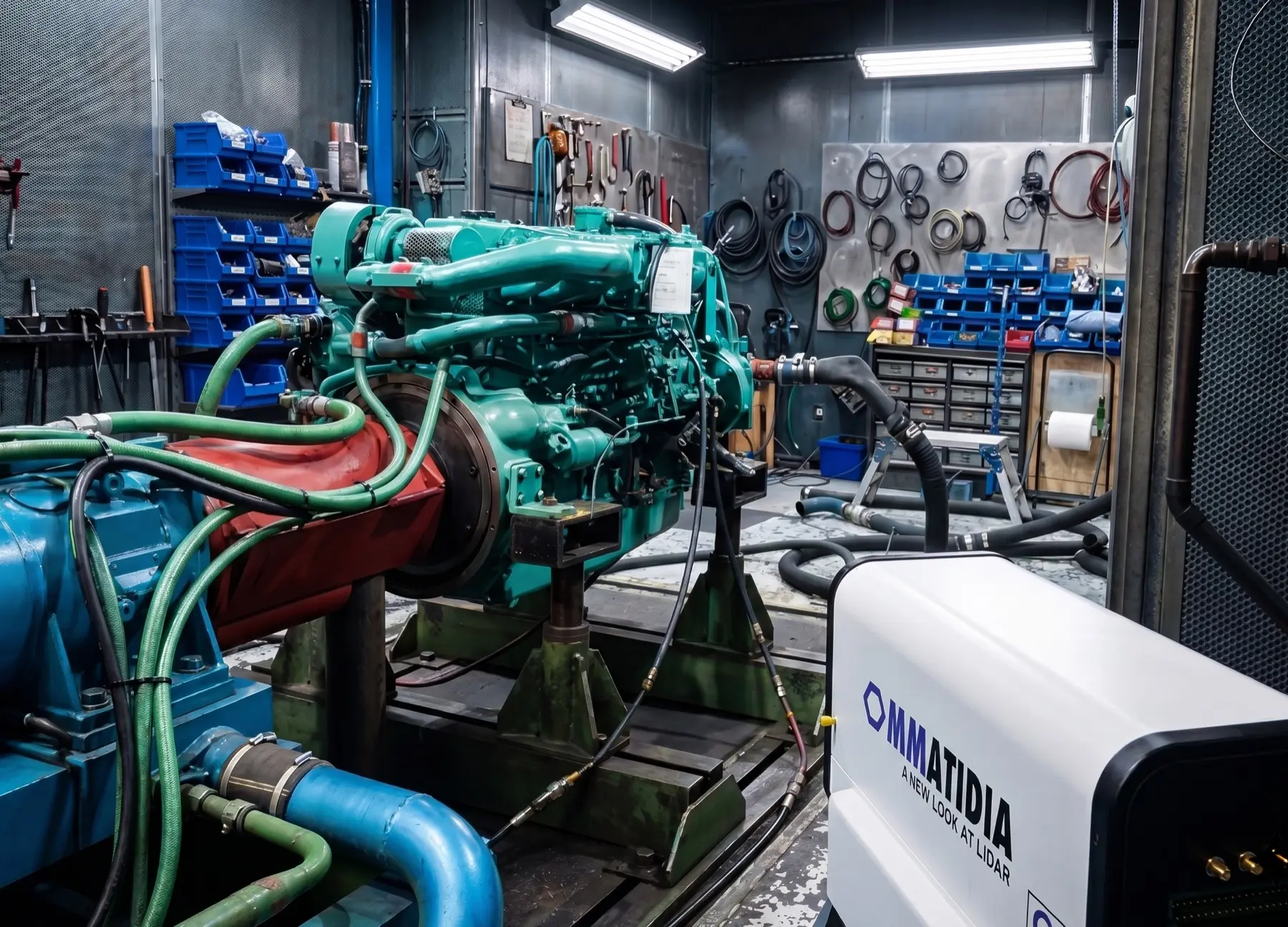
Q2 acquired spatially dense vibrometry data on a large generator operating in steady state at nominal 3600 RPM.
Key Facts
In this Case Study we show the capabilities of our Q2 system for vibration analysis of large rotating machinery: >> We scanned an electric generator operating in steady state at a nominal rotation rate of 3600 RPM, acquiring 101 scan frames with the 65 simultaneous laser channels of the Q2. >> Each frame contains 1 s of data sampled at 40 kHz, while the scan swept the azimuth angle from 0.0° to 46.0° in 0.46° steps. >> A shaft tachometer produced one pulse per revolution and fed Q2’s analog input. We used that tach signal to estimate RPM per frame and to reference order phase consistently from frame to frame.
Article PDF
Click below to download the Case Study
Introduction Measurement objectives
This project evaluates how Q2 supports vibration analysis on large rotating machinery under realistic test conditions. Q2 operates in two main modes: Vibrometry mode, which measures surface velocity, and Metrology mode, which measures distance and builds a 3D point cloud of the scene. The system uses multichannel coherent detection and a frequency modulated continuous wave (FMCW) laser source. This architecture supports measurement of vibration and distance at all 65 channels, enabling 3D characterisation of dynamic behaviour. In addition, Q2 integrates Ommatidia’s SpeckleGuard™ speckle management algorithms, which stabilise LDV data on difficult, rough or low reflectivity surfaces, and the DOLL™ digital optical locked loop, which extends the usable velocity range of the vibrometer by a 10x factor. The system is controlled from Ommatidia Atelier™, which handles configuration, acquisition, and export; and for the data analysis, we used a pre release version of the vibration processing pipeline developed in Python.The test includesKey capabilities relevant for NVH investigations
Sampling up to 40 kHz across 65 parallel channels, a standard velocity range of ±15.5 mm/s in LDV mode, expandable with DOLL™; fast scanning over large azimuthal angles to map the full field of view, and open HDF5 data format for integration into existing analysis workflows.During the scanOperation conditions
The generator operates in steady state near a nominal 3600 RPM. Small frame‑to‑frame speed variation is visible in the tach‑derived RPM estimate, and we use the per‑frame tach‑derived rotation rate for order analysis.MethodsWe set out to
Verify adequate optical return across the intended field of view before vibration acquisition. Acquire spatially dense vibration data using Q2’s 65 channels while scanning the generator. Use a one-pulse-per-rev shaft tachometer (captured on Q2) to track speed per frame and define a phase reference. Produce order response maps (amplitude and tach-referenced phase) and provide summary views that facilitate expert interpretation. Provide an initial diagnostic estimate of residual, non-order vibration energy to guide discussion and validation.Take-awaysConclusions
This analysis uses precise methods to highlight only meaningful vibration behavior, displaying phase information only when it can be reliably interpreted. It also includes a residual energy metric to help identify non-synchronous effects. Overall, this approach offers a solid foundation for understanding the generator’s vibration behavior and supporting future diagnostics and maintenance. The results clearly show the main vibration patterns, along with the remaining vibration energy in the 0–3000 Hz range. This provides a valuable first look for diagnostic purposes. Also, high-resolution data was captured from multiple angles using an advanced measurement system, with a shaft tachometer ensuring everything was synchronized with the machine’s actual rotation.
Scanning an electric generator operating in steady state at a nominal rotation rate of 3600 RPM
Acquiring 101 scan frames with the 65 simultaneous laser channels of the Q2. Each frame contains 1 s of data sampled at 40 kHz, while the scan swept the azimuth angle from 0.0° to 46.0° in 0.46° steps.
Ommatidia Upgrade & Trade-In Program
Upgrade to Ommatidia’s latest Laser RADAR technology and unlock more capability for your next measurement challenge. Whether you are expanding an existing setup or replacing an older system, we offer tailored upgrade options with discounts of up to 40%.
If you are currently using another manufacturer’s system, send us your model and measurement requirements. We will review your trade-in possibilities, identify the best Ommatidia configuration, and outline a practical upgrade path for your team.