Towards Non-Contact, Remote Measurement of Structural Dynamics and SHM at Scale
Accurate monitoring of bridge deflection and vibration is essential for understanding structural performance, fatigue behavior, and long-term safety. Traditional methods—such as strain gauges, accelerometers, and displacement transducers—provide local information but require contact installation, surface preparation, and often disrupt traffic.
At Ommatidia, we are advancing non-contact bridge monitoring through our Q-Series Laser Doppler Vibrometer. This system combines multi-channel coherent sensing and advanced photonic integration, enabling simultaneous 3D measurement of vibration and displacement across entire bridge spans—from a safe, remote location.
By monitoring bridge deflection with Ommatidia’s Q-Series Laser Doppler Vibrometer, engineers can now achieve precision interferometric measurements at field scale without interrupting operations.
Technical Insights: From Optical Coherence to Structural Dynamics
At the heart of the system lies Frequency Modulated Continuous Wave (FMCW) interferometry, a laser-based technique that measures absolute distance and Doppler velocity through frequency-swept sources.
Using massively parallel photonic integrated circuits (PICs), the Q-Series sensor analyzes 128 optical channels in real time. Each channel performs interferometric ranging and vibrometry simultaneously.
This architecture enables the system to deliver:
-
Sub-millimeter displacement resolution at ranges beyond 50 meters
-
Simultaneous measurement of hundreds of points with coherent phase stability
-
Multi-kilohertz sampling rates suitable for modal and transient response analysis
These features make the Q-Series Laser Doppler Vibrometer ideal for continuous or load-test bridge deflection monitoring.
Learn More About the Q2 Laser Radar →
Field Test: Measuring Deflection in a Multi-Span Road Bridge
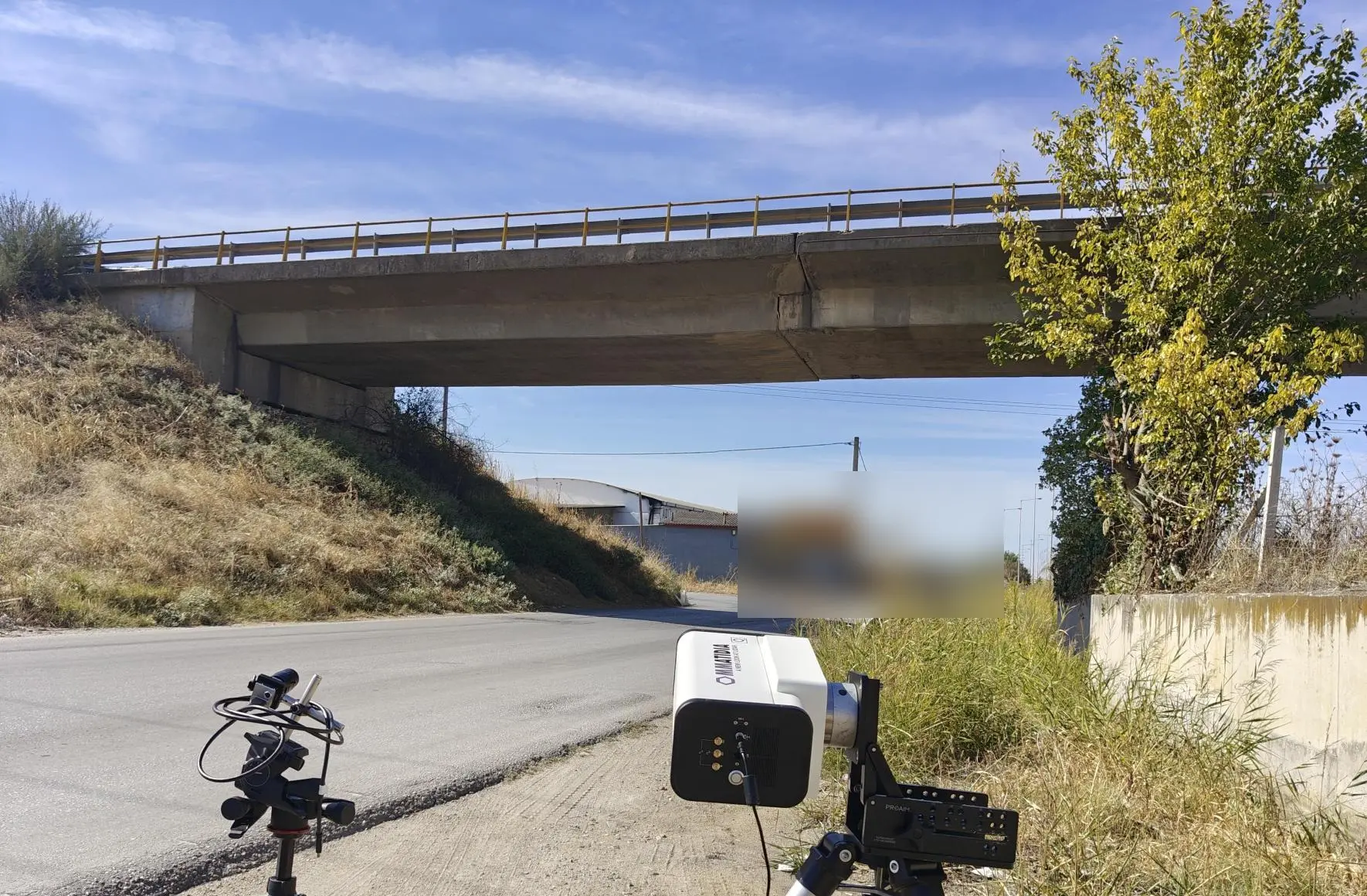
In a recent field test, we deployed a Q1s FMCW Laser Doppler Vibrometer beneath a multi-span road bridge on Calle de la Hierbabuena, Tres Cantos, Spain (Figure 1).
The setup was completed within minutes using only a tripod-mounted sensor head, computer, and batteries. The 128 laser channels were aligned along the axis of the bridge deck to record the deflection profile during live traffic.
Related bridge strain workflow
Connect deflection to strain: the bridge-strain application note explains how dense Q-series LDV deflection profiles can be converted into curvature and surface strain when the beam model is valid.
Read the connected non-contact bridge strain application note.

Google Maps view (left) and image of the bridge (right). Bridge deflection monitoring setup using Ommatidia’s Q-Series Laser Doppler Vibrometer.
To streamline data collection, Ommatidia developed Deflection Guard™, a software suite designed for real-time bridge deflection monitoring. It combines laser radar (distance) and laser Doppler velocimetry (velocity) modes for maximum accuracy. How Deflection Guard™ works: The user enters the distances from the Q1s unit to bridge pillars and the tripod height. Measurements are taken every 50 ms, allowing full data or video reconstruction later. The first scan defines a baseline for absolute distance and height at each measurement spot. The system then switches to velocimetry mode, capable of detecting velocities down to 10 nm/s and displacements in the picometer range. Bridge deflection can be measured within minutes, safely and remotely, without placing any worker in danger.Deflection Guard™ Software for Real-Time Monitoring

Configuration of the measurements. The dotted green line is a guide to the eye. Bridge deflection monitoring setup using Ommatidia’s Q-Series Laser Doppler Vibrometer.
Results: Real-Time Bridge Deflection and Vibration Data
During live traffic testing, Deflection Guard™ captured the bridge’s deflection profile as a truck passed overhead.
The maximum vertical deflection recorded was approximately 0.3 mm.
The dynamic data, acquired at 40 kHz, also enable detailed modal and transient vibration analysis.
Deflection Guard™ interface showing unloaded and loaded bridge states.
Software interface displaying bridge deflection before and after truck passage.
From Load Test to Digital Twin Development
The collected datasets form the foundation of a digital twin for the bridge.
By processing these data, engineers can extract modal parameters, frequency response functions, and indicators of damping or stiffness. Over time, this information allows visualization of structural changes and early detection of degradation long before visible damage occurs.
Recent developments include:
-
Multi-unit synchronization for large or multi-span bridges
-
Continuous unattended monitoring for long-term SHM
-
Automated data fusion and dashboard integration for real-time insights
Towards Scalable Structural Health Monitoring
This study demonstrates how non-contact optical vibrometry can complement or replace traditional bridge instrumentation.
By eliminating the need for sensor installation, the Q-Series Laser Doppler Vibrometer enables rapid deployment, minimal maintenance, and continuous coverage—ideal for modern infrastructure management.
For structural dynamics researchers, it provides a new method to validate models and analyze modal interactions.
For civil and bridge engineers, it offers an efficient, field-ready tool for maintenance planning, life-extension analysis, and post-event assessment.
As Ommatidia expands into railway and highway monitoring, the Q-Series continues redefining optical Structural Health Monitoring (SHM) with earlier anomaly detection, safer inspections, and smarter asset management.
About Ommatidia
Ommatidia LiDAR S.L. designs and manufactures advanced FMCW LiDAR systems powered by photonic integrated circuits.
Its Q-Series Laser RADAR platform delivers high-precision metrology and scalable architecture for industrial inspection, aerospace instrumentation, and civil infrastructure monitoring.
Bridge-deflection measurement questions
Use the published road-bridge test as a bounded example, then define the evidence needed for the real structure.
How did the published bridge test measure deflection?
A tripod-mounted Q1s used 128 optical channels aligned along the bridge deck. Deflection Guard first established an absolute-distance and height baseline at each spot, then used velocimetry for the dynamic response. The setup recorded unloaded and truck-loaded states during live traffic without installing sensors on the deck.
What spatial and time-resolved data were captured?
The channels measured points along the deck simultaneously. The workflow stored measurements every 50 ms for profile and video reconstruction, while the published dynamic dataset was acquired at 40 kHz for modal and transient analysis. These are different outputs of the documented field workflow, not universal settings for every bridge.
What was the measured deflection?
The maximum vertical deflection reported as a truck crossed this multi-span road bridge was approximately 0.3 mm. That value belongs to this bridge, load event, geometry and setup; it is not a generic limit or acceptance threshold for other structures.
Does an optical deflection map establish that a bridge is safe?
No. It provides non-contact displacement and vibration evidence for structural engineers. A decision still requires the applicable bridge model, load case, boundary and environmental conditions, reference checks, uncertainty, inspection evidence and project-specific acceptance criteria.
Ommatidia Upgrade & Trade-In Program
Upgrade to Ommatidia’s latest Laser RADAR technology and unlock more capability for your next measurement challenge. Whether you are expanding an existing setup or replacing an older system, we offer tailored upgrade options with discounts of up to 40%.
If you are currently using another manufacturer’s system, send us your model and measurement requirements. We will review your trade-in possibilities, identify the best Ommatidia configuration, and outline a practical upgrade path for your team.